

Carlos Cruz Diez
Carlos Cruz-Diez was one of the main protagonists of contemporary art and one of the most influential figures in the development of Kinetic and Optical Art. Born in Caracas, Venezuela, in 1923, and based in Paris from 1960, he dedicated more than seven decades to researching the phenomenon of color and its relationship with perception, space and time.
Cruz-Diez developed a radically new approach to color, proposing it as an autonomous and evolving reality rather than simply an element used to describe forms. His work invites the viewer to experience color as an event that unfolds in space and time, constantly changing according to movement, light and perception.
After studying at the Escuela de Artes Plásticas y Aplicadas de Caracas, Cruz-Diez began his career working across painting, illustration, graphic design and advertising. His early interest in the expressive possibilities of color progressively led him toward the investigations that would define his artistic practice. In the late 1950s, he developed his first major experiments with light and color, including the beginnings of his Couleur Additive and Physichromie series.
In 1960, Cruz-Diez moved permanently to Paris with his family, establishing a studio that would become the centre of his artistic and intellectual activity. From there, he developed an international career, exhibiting extensively in Europe, the Americas and Asia and becoming a key figure within the international Kinetic and Optical Art movements.
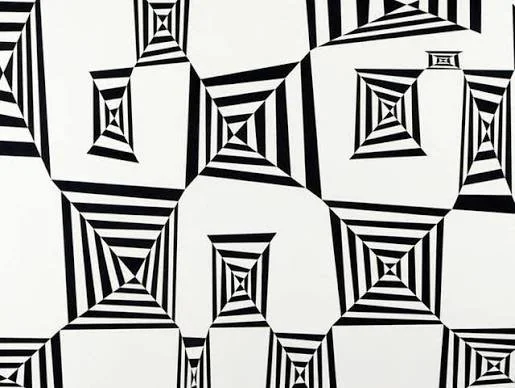
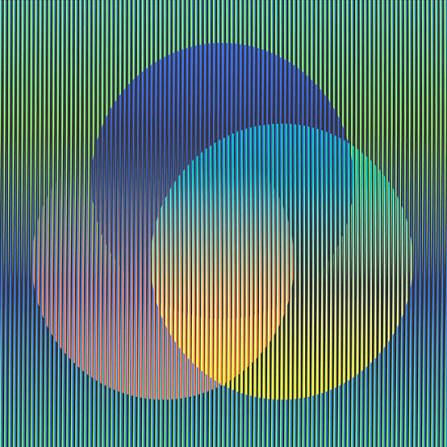
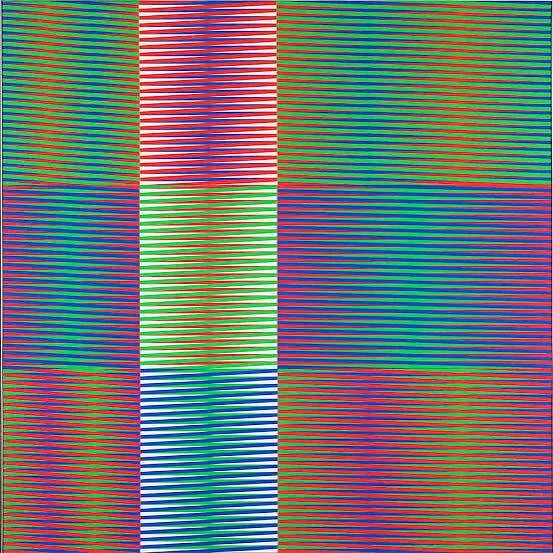
His artistic research is structured around eight major lines of investigation: Couleur Additive, Physichromie, Induction Chromatique, Chromointerférence, Transchromie, Chromosaturation, Chromoscope and Couleur à l’Espace. Each explores different behaviours and manifestations of color, creating works in which perception becomes an active and constantly changing experience.
Cruz-Diez's work was presented in landmark exhibitions including The Responsive Eye at the Museum of Modern Art in New York in 1965, the 35th Venice Biennale in 1970, and major exhibitions at the Tate, Centre Pompidou, Museum of Fine Arts Houston, Museo Reina Sofía and other leading international institutions. His work was also the subject of major solo exhibitions, including Carlos Cruz-Diez: Color in Space and Time at the Museum of Fine Arts, Houston, in 2011.
Beyond galleries and museums, Cruz-Diez developed numerous large-scale environmental and public artworks, extending his research into architecture and urban space. His practice transformed color into an immersive experience, encouraging viewers to become active participants in the creation of the work rather than simply observers.
His work is held in the permanent collections of some of the world's most prestigious museums, including the Museum of Modern Art (MoMA) in New York, Tate Modern in London, Centre Pompidou in Paris, Musée d’Art Moderne de la Ville de Paris, Museum of Fine Arts Houston, Hirshhorn Museum and Sculpture Garden in Washington, D.C., and Louisiana Museum of Modern Art in Denmark.
Throughout his career, Cruz-Diez also devoted himself to teaching, writing and theoretical research on color. His reflections were published in works including Reflexión sobre el color (1989), contributing to a broader understanding of the perceptual and scientific dimensions of his artistic practice.
Carlos Cruz-Diez died in Paris in 2019, leaving behind one of the most important bodies of work devoted to color in 20th- and 21st-century art. His artistic legacy continues through the Atelier Cruz-Diez in Paris, Articruz in Panama and the Cruz-Diez Foundation, which work to preserve, study and disseminate his work and ideas.
Art works
Career I Exhibitions
1923
Born in Caracas, Venezuela, on 17 August.
1940
He enrols at the School of Plastic and Applied Arts in Caracas, where he begins his formal artistic training.
1944–1955
He works as an illustrator and graphic designer while developing his painting practice. During these years, he progressively moves away from figurative representation and begins to investigate the expressive and perceptual possibilities of colour.
1955
He travels to Europe for the first time, visiting Barcelona and Paris. This experience brings him into contact with the European avant-garde and strengthens his interest in abstraction, colour and perception. Back in Caracas, he begins developing the ideas that will lead to his first Physichromies and Couleurs additives.
1959
He creates the first Couleur additive and Physichromie, marking a decisive turning point in his artistic research. Rather than using colour to represent an object, he begins to explore colour as an autonomous phenomenon that changes according to light and the viewer's position.
1960
He moves permanently to Paris with his family. The city becomes the centre of his artistic activity and allows him to engage with an international network of artists working around Kinetic and Optical Art.
1964
He participates in Mouvement 2 at Galerie Denise René in Paris, one of the important exhibitions contributing to the development of Kinetic Art in Europe.
1965
He is included in The Responsive Eye at the Museum of Modern Art in New York, the landmark exhibition that brought international attention to Optical Art. During the same period, he develops his Transchromies, environments in which transparent coloured surfaces transform the viewer's perception of surrounding space.
1966–1967
His international recognition continues to grow. Physichromie becomes one of the central bodies of work in his practice, while he receives the Grand Prize at the III American Art Biennial in Córdoba in 1966 and the International Painting Prize at the IX São Paulo Biennial in 1967.
1969
He develops his Labyrinthe de Transchromies, an immersive environment in which translucent coloured panels continuously transform the perception of the surrounding space according to the viewer's movement and the ambient light. The work is presented at Galerie Denise René in Paris.
1970
He begins producing Physichromies on a monumental scale, extending his research beyond the traditional dimensions of painting. One of these works is presented at the Venice Biennale. His work increasingly integrates architecture and public space into his exploration of colour.
1970s
He develops several new lines of research, including Induction Chromatique, Chromointerférence and Transchromie. His work increasingly focuses on making colour an active and changing phenomenon, rather than a fixed element contained within a composition.
1981
His work is presented in Didáctica y dialéctica del color. Intervenciones en la arquitectura. Inducciones cromáticas at the Caracas Museum of Contemporary Art, highlighting the relationship between his research into colour, architecture and public space.
1980s–1990s
Cruz-Diez continues to develop his principal lines of research, including Couleur additive, Physichromie, Induction Chromatique, Chromointerférence, Transchromie, Chromosaturation and Couleur à l'espace. His investigations extend from paintings and reliefs to immersive environments and architectural interventions.
1993
His work is included in Manifeste, Une histoire parallèle (1960–1990) at the Centre Pompidou in Paris, reaffirming his place within the history of international post-war abstraction and Kinetic Art.
2001
The Centre Pompidou presents Denise René, l'intrépide, an exhibition devoted to the influential Parisian gallery and its role in the history of Kinetic and Optical Art, with Cruz-Diez among the artists represented.
2002
He is appointed Commandeur de l'Ordre des Arts et des Lettres by the French Ministry of Culture, recognising his contribution to the arts.
2003
He participates in Une Tour Eiffel haute en couleurs, an exhibition and public programme at the Eiffel Tower in Paris, where his approach to colour is brought into dialogue with architecture and the urban environment.
2004
His work is included in MoMA at El Museo: Latin American and Caribbean Art from the Collection of The Museum of Modern Art in New York.
2011–2012
The Museum of Fine Arts, Houston presents Carlos Cruz-Diez: Color in Space and Time, a major retrospective of his research into colour. The exhibition subsequently travels to the Museo Nacional de Bellas Artes in Buenos Aires, the Museo de Arte de Lima and the Pinacoteca do Estado de São Paulo.
2012
He is appointed Officer of the French National Order of the Legion of Honour.
2016–2017
He presents Un Être Flottant in Paris, including an outdoor exhibition at the Palais d'Iéna. His work continues to explore the relationship between colour, architecture, movement and perception.
2017
His Environnement de Transchromie Circulaire is presented at FIAC Paris Hors les Murs at Place de la Concorde, transforming colour into an immersive spatial experience.
2019
His work is included in Paris et nulle part ailleurs. 24 artistes étrangers à Paris. 1945–1972 at the Musée de l'Histoire de l'Immigration in Paris, featuring Labyrinthe de Transchromie B.
27 July 2019
Carlos Cruz-Diez dies in Paris at the age of 95, leaving behind one of the most important bodies of research into colour, perception and movement in 20th- and 21st-century art. His works remain in the permanent collections of major international institutions including the Museum of Modern Art in New York, Tate in London, Centre Pompidou and Musée d'Art Moderne de Paris.
2024
The Centre Pompidou-Málaga presents Carlos Cruz-Diez: El color en movimiento, a major exhibition dedicated to his research into colour in movement. The same year, Galleria Continua presents L'Euphorie de la couleur in Paris, bringing together key works from across his career.