

Antonio Segui
Antonio Seguí was one of the most important Argentine artists of the 20th and early 21st centuries, internationally recognized for his distinctive figurative language, characterised by humorous, energetic and often satirical representations of modern urban life.
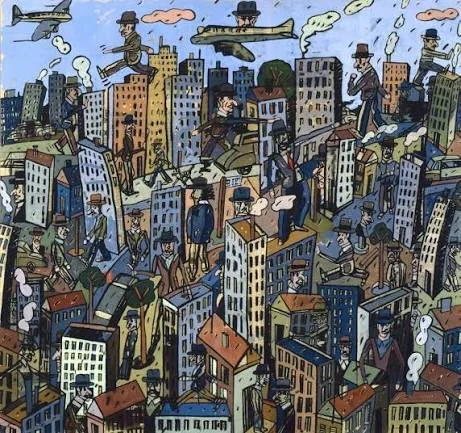
Born in Córdoba, Argentina, in 1934, Seguí developed a multidisciplinary practice encompassing painting, drawing, sculpture, printmaking and illustration. His work combines elements of popular culture, social commentary and personal observation, creating imaginary worlds populated by crowds of small, restless figures that move through urban landscapes.
Seguí travelled extensively throughout Europe, North Africa and Latin America during his formative years, encounters that profoundly influenced his artistic development. After studying painting and sculpture in Córdoba, he continued his education in Madrid and Paris and travelled through Switzerland and Central Europe, where he encountered the work of European modernist and avant-garde artists.
In the early 1960s, Seguí moved between Argentina and Europe before settling permanently in Paris in 1963. From there, he developed an international career and became closely associated with the New Figuration movement, while maintaining a highly personal style that combined figuration, abstraction, caricature and social criticism.
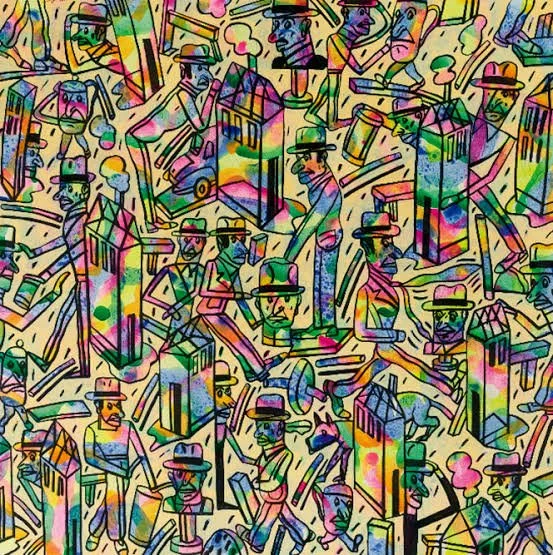
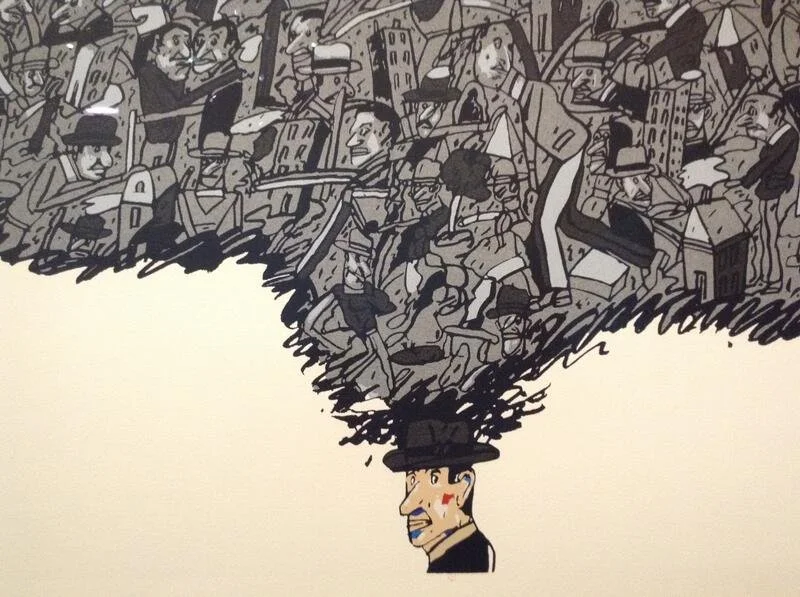
His paintings are populated by his characteristic hombres urbanos — anonymous, suit-wearing men and women whose frantic movements and exaggerated gestures evoke the absurdity and contradictions of contemporary society. Often appearing in large groups, these figures create a sense of constant movement, confusion and collective behaviour.
Humour is a fundamental element of Seguí's work. Behind its playful and seemingly spontaneous appearance lies a sharp observation of human behaviour, social conventions, political power and the pressures of modern urban life. His characters can appear lost, running, arguing, falling or simply moving aimlessly, reflecting both the comic and unsettling aspects of everyday existence.
From the 1960s onwards, Seguí exhibited extensively throughout Europe, the Americas and Asia. His work was presented at major international exhibitions and biennials, including the Venice Biennale, the São Paulo Biennial and numerous exhibitions in France, Argentina, Spain, Germany, Italy and the United States.
Seguí also developed an important body of sculptural work. His monumental sculptures translated the lively characters and dynamic compositions of his paintings and drawings into three-dimensional forms, allowing his imaginary crowds to occupy public and urban spaces.
His work is held in numerous international public and private collections, including the Centre Pompidou in Paris, the Musée d'Art Moderne de Paris, the Museum of Modern Art in New York, the Hirshhorn Museum and Sculpture Garden in Washington, D.C., the Museo Nacional de Bellas Artes in Buenos Aires and the Museo de Arte Moderno de Buenos Aires.
Throughout his career, Seguí received numerous distinctions and represented Argentina internationally, establishing himself as a key figure of Latin American contemporary art. His work continues to be recognised for its unique combination of humour, social observation and an instantly recognisable visual language.
Antonio Seguí died in Buenos Aires in 2022, leaving behind an extensive and influential body of work spanning more than six decades. His lively crowds of anonymous figures remain one of the most recognisable images in contemporary Argentine art, bridging painting, drawing and sculpture while offering a playful yet critical reflection on modern society.
Art works
Career I Exhibitions
1934
Born in Córdoba, Argentina, on 11 January.
1948–1951
He begins his artistic training in Córdoba, studying painting and drawing while also developing an interest in literature and illustration.
1951–1954
He travels through Europe, visiting Spain, France, Switzerland, Germany and Italy. In Madrid and Paris, he encounters European modern art and studies the work of artists who will influence his early development.
1957
He returns to Argentina and begins exhibiting his work. His early paintings show the influence of European modernism while already revealing his interest in caricature, humour and social observation.
1958
He travels to Mexico, where he discovers the work of the Mexican muralists and becomes increasingly interested in political and social subjects.
1960
He presents his first solo exhibitions in Argentina and begins to establish himself within the country's emerging contemporary art scene. His work gradually moves away from abstraction towards a more figurative and personal language.
1963
He settles permanently in Paris. The city becomes his principal base for the rest of his career and allows him to participate in the international contemporary art scene.
1964–1965
His work begins to attract international attention. He develops a distinctive figurative language combining caricature, distorted perspectives and fragmented spaces. His paintings increasingly feature anonymous characters and groups of people, anticipating the urban crowds that will become central to his work.
1966
He participates in the XXXIII Venice Biennale, representing Argentina. His international visibility continues to grow through exhibitions in Europe and Latin America.
Late 1960s
Seguí develops his characteristic universe of small, anonymous figures. Men in suits, women, pedestrians and crowds populate his paintings and drawings, often appearing to run, argue, fall or move chaotically through imaginary urban environments.
1970s
His international career expands considerably. He exhibits throughout Europe, Latin America and the United States, while developing an increasingly recognisable combination of humour, caricature and social criticism.
During this period, the human figure becomes the central subject of his work. His characters appear simultaneously comic and unsettling, reflecting the absurdity of modern urban life and the pressures of collective society.
1974
He participates in the XXXVIII Venice Biennale. His work is increasingly associated with the renewal of figurative painting in Latin American art.
1977
He receives the Grand Prize at the São Paulo Biennial, consolidating his position as one of the leading Argentine artists of his generation.
1980s
Seguí expands his practice beyond painting and drawing, producing prints, lithographs and sculptures. His characteristic figures begin to appear in three-dimensional form, allowing his imaginary crowds to occupy architectural and public spaces.
1983
He receives the Konex Award in Argentina, one of the country's major cultural distinctions.
1984–1985
His work is presented in major exhibitions across Europe and Latin America. He continues to develop his urban imagery, introducing increasingly complex compositions populated by hundreds of figures.
1990s
Seguí's work is shown extensively in museums, galleries and international exhibitions. His figures become increasingly dynamic and fragmented, often appearing to move through enormous architectural environments.
He also produces a growing number of monumental sculptures, translating the characters of his paintings into playful three-dimensional forms.
1991
He is awarded the International Grand Prize at the Biennial of Graphic Arts in Ljubljana, recognising his contribution to printmaking.
1994
A major retrospective of his work is presented in Argentina, bringing together paintings, drawings, prints and sculptures from across his career.
2000s
Seguí continues to work between Paris and Argentina, producing paintings, drawings and sculptures. His visual vocabulary becomes increasingly economical and immediately recognisable: simplified figures, intense movement, urban crowds and a constant tension between humour and social criticism.
2005
His work is presented in numerous international exhibitions dedicated to Latin American modern and contemporary art, reaffirming his position within the international history of figurative art.
2010s
His work continues to be exhibited internationally, with major presentations in France, Argentina, Spain, Italy, Germany and the United States. Museums and institutions increasingly focus on the relationship between his work, caricature, urban life and social commentary.
2014
He is honoured with the Konex Platinum Award for Visual Arts in Argentina, recognising his outstanding career.
2016–2019
His paintings, drawings and sculptures continue to be shown in solo and group exhibitions internationally. His characteristic crowds of anonymous figures remain at the centre of his artistic language, exploring movement, individuality and collective behaviour.
2021
Major exhibitions and retrospectives continue to highlight his contribution to Argentine and Latin American contemporary art, bringing together works spanning several decades of his career.
13 February 2022
Antonio Seguí dies in Buenos Aires at the age of 88. He leaves behind an extensive body of work spanning more than six decades and encompassing painting, drawing, printmaking, sculpture and illustration.
His work remains represented in major international collections, including the Centre Pompidou in Paris, the Museum of Modern Art in New York, the Hirshhorn Museum and Sculpture Garden in Washington, D.C., and leading museums in Argentina and Latin America.